
Electronic Strategy Board Game: Real Travel Fix or Filler?
A buyer's guide to the Electronic Strategy Board Game: what the 7 modes include, who the 8x8 LED board suits, and what to know before gifting it.
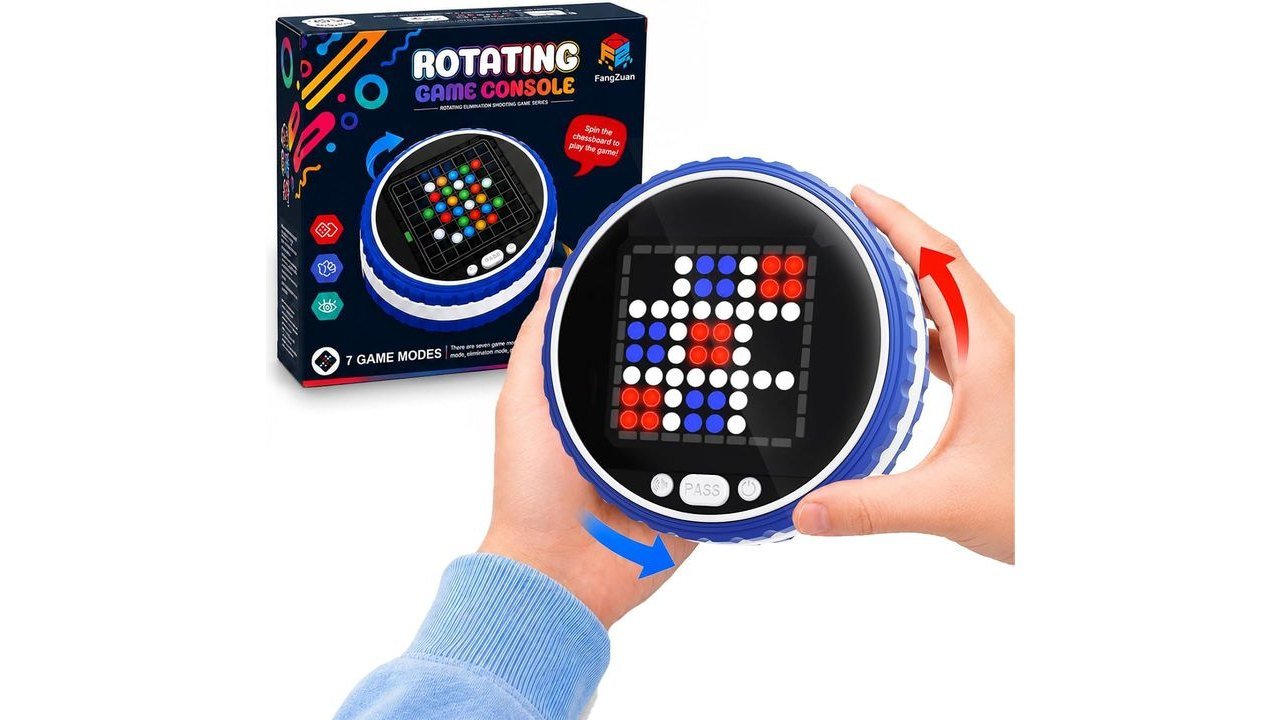
The Electronic Strategy Board Game is worth buying for parents who want a screen-free travel toy for kids 7 and up. It packs seven game modes into a handheld LED board with no loose pieces and a full mute option. Skip it if your kid expects color graphics or you’re buying for a teen.
This post contains affiliate links. I may earn a commission at no extra cost to you.
Three Hours Into a Road Trip, Somebody Asks for the Tablet
That’s the moment this thing is built for. The back seat goes quiet, then restless, and the easiest fix is also the one most parents feel vaguely bad about handing over. The Electronic Strategy Board Game is the alternative: a handheld with an 8×8 LED grid, seven game modes, no Wi-Fi, no apps, and no ads.
It also solves the other travel-game problem. Magnetic chess sets shed pieces under car seats. Card decks scatter. There’s nothing here to lose, because there’s nothing here that isn’t bolted into the case.
| Display | 8×8 LED grid |
|---|---|
| Game modes | 7 (4 with 99 levels) |
| Power | 3× AA (not included) |
| Age rating | 7+ (listing) |
| Warranty | 12-month manufacturer |
Does the 7-in-1 Claim Hold Up?
Partly. Seven modes are real, but only four of them scale. Shooting, Catching, Elimination, and Minesweeper each run up to 99 progressive difficulty levels, with the next unlocking automatically and a voice prompt marking the level-up. That’s where the replay value lives.
The other three are Gomoku against the AI, Gomoku two-player, and Tic-Tac-Toe. Those don’t have a level ladder, they have an opponent. Tic-Tac-Toe is a thirty-second game for a seven-year-old and a solved game for anyone older, so treat it as a bonus rather than a reason to buy.
So the marketing headline is a little generous. Four genuinely deep modes plus three quick ones is still a lot for something this size, but “99 levels” doesn’t apply across the board and a buyer deserves to know that before the box opens.
The Specs, Translated
Each spec on the listing maps to a specific travel annoyance. Here’s the translation.
Compact size. That’s a backpack side pocket or a glovebox, not a jacket pocket. Small enough that it doesn’t earn its own bag, chunky enough that it won’t disappear into a seat crease.
Low-power 8×8 LED grid. The simplicity is the feature. LEDs sip power compared to a backlit color screen, which is why 3 AA batteries can carry a device like this far longer than a handheld with an LCD. The trade-off is unavoidable: this looks like a grid of lights, because it is one.
Adjustable volume with full mute. This matters more than it sounds. Voice prompts call out level-ups and win/loss results, which is great in a car and terrible on a plane at 11pm. The volume drops all the way to silent, so the device works in a quiet cabin or a restaurant waiting area without turning the whole table toward you.
Rotary dial control. Most of the near-identical 7-in-1 LED handhelds on Amazon use buttons only. The dial is the one hardware difference reviewers point to as an upgrade, since moving a cursor across an 8×8 grid by spinning is faster than tapping a direction pad repeatedly. It’s also the part a parent should watch, because a dial is a moving part and moving parts are what kids break first.
Automatic win/loss judgment. No scorekeeping, no arguing about whether five in a row counted. The device calls it. In a two-kid back seat, that’s less refereeing from the front.
Is It Really Better Than Handing Over a Tablet?
Different, not strictly better. A tablet wins on content volume and visual richness by a mile. This wins on everything surrounding the content: no ads, no in-app purchases, no Wi-Fi dependency, no drain on the phone you need for navigation, and no negotiation about what gets watched.
Against a Switch Lite or a similar handheld console, the gap is wider still and so is the price, several times over. Nobody should cross-shop these. One is a games machine, the other is a stocking stuffer that keeps a kid busy between exits.
Against card-based travel games, the deciding factor is whether a kid has a willing opponent. Cards are more social and need no batteries. This has an AI opponent in Gomoku, which is the whole argument for it when the other passenger is asleep.
Worth Knowing Before You Buy
The batteries aren’t in the box. Three AAs, not included, which is a real problem if this is going under a tree on a holiday morning. Buy a pack with it.
The age guidance is inconsistent. Features say 7+, the manufacturer minimum listed elsewhere is 36 months. Trust the 7+ number. Minesweeper and Gomoku both require reasoning a three-year-old doesn’t have yet, and a frustrated kid puts the toy down for good.
Two-player mode means two players around one device. Both heads have to be in front of the same 8×8 grid, which works at a table and gets awkward across two car seats with a center console in between.
And durability is the open question. The manufacturer is a generic toy factory, there’s a 12-month warranty, and no long-term independent data exists on how the dial and casing hold up to a year of backpack life. For the price bracket that’s normal. It’s still the thing to weigh if you’re buying for a hard-on-toys seven-year-old.
Who Should Buy the Electronic Strategy Board Game
Parents of kids roughly 7 to 12 who travel. That’s the center of the target. Logic, memory, focus, and pattern recognition all get a workout across Minesweeper and Gomoku, and the 99-level ladder gives a kid the “one more level” pull without a subscription attached to it.
It’s also a reasonable gift pick for an adult who likes puzzle games in short bursts, the kind of person who plays Minesweeper on a laptop between meetings. Low stakes, grab-and-go, no setup.
It’s not for teens who game seriously, anyone expecting a color display, or a household already deep into tactile board games where the physical pieces are half the appeal. If the travel problem you’re solving is specifically “I don’t want to hand over a phone,” though, this is an easy one to try. See today’s price on the product page.
Frequently Asked Questions
Where is the battery compartment, and how do I change the AAs?
On compact handhelds in this format the compartment sits underneath the base, usually behind a small screwed panel. That means you’ll likely need a small Phillips screwdriver rather than popping a clip, which is standard child-safety practice on battery doors in toys.
What does the 12-month warranty actually cover?
It’s a 12-month manufacturer warranty, which typically covers defects rather than drops, water, or a dial broken by rough handling. Amazon’s own return window applies separately and is usually the faster route in the first 30 days.
Can it be used on a plane during takeoff and landing?
Yes, because there’s no wireless radio in it at all. No Wi-Fi, no Bluetooth, no app pairing, so there’s nothing to switch to airplane mode. Just mute the volume before boarding.
How does it compare to the other near-identical 7-in-1 LED handhelds on Amazon?
Most of them share the same OEM hardware, similar game menus, and similar pricing. The rotary dial is the main differentiator here versus button-only competitors. If you find a cheaper clone with buttons instead of a dial, the games are probably the same and the navigation is slower.
Get it now
Electronic Strategy Board Game, 7-in-1 Car Travel Games, Road Trip Games
Get the best price on Amazon →This post contains affiliate links. I may earn a commission at no extra cost to you.